Friday, July 20, 2012

Normandy, France: Omaha Beach and the American Cemetary


Omaha Beach


Omaha Beach was the second stop we made on our tour of Normandy. As most people know, it was part of a larger operation to move in and secure several geographical areas (among them Utah, Omaha, Gold, Juno, Sword beaches) to connect Allied forces, uniting efforts to combat German military.


Coast Guard Memorial at Omaha Beach


View looking east from west side of Omaha Beach


Even after visiting Normandy, I can't begin to describe all the events that happened that day and subsequently. But to summarize, it was a very daunting task with geographical and meteorological challenges, gruesome bloodshed, and what seems to me to be a miraculous victory in the long run. The movie Saving Private Ryan, although a fictitious story, depicts some very lifelike scenes of the D-Day landings.


Omaha Beach was the site of the first American Cemetery in France, but it was later moved to another location nearby. We drove a short distance to also visit the Normandy American Cemetery and Memorial in France, which now contains the graves of 9,387 military, most of whom lost their lives during the D-Day invasions.


A Time Capsule to be opened 100 years after D Day (2044)

Beginning our walk through the cemetery


We explained to the kids that each cross represented an American person who died fighting to help other people. It is a hard concept for young kids, but when faced with a visual of so many crosses representing so many people, I thought it was worth a try. It is a beautiful, peaceful tribute to so many courageous soldiers.


1,557 names are inscribed on the Walls of the Missing, which is a semicircular garden. The names of those since recovered and identified are marked with rosettes.

It struck me that it was nothing short of amazing--standing in these spots and hearing the obstacles that were overcome by some very brave fellow Americans. You can be sure my very next thought was a prayer of immeasurable thanks. The world would be a very different place if not for this turning point in history. Here's hoping future generations will look back knowing we did what was needed for this this day and age...I'm not so sure, but that's another whole blog.


Normandy, France: Point Du Hoc

Point Du Hoc was an amazing first historical site to see during our Normandy visit. It was where, on D Day June 6, 1944, U.S. Army Rangers scaled a steep 100-foot cliff with ropes and ladders to surprise and attack German bunkers, which held six canons. Point du Hoc is situated between Omaha beach and Utah beach, so the mission to disarm the Germans here was integral to the success of the Omaha and Utah beach invasions.

Replica of a German canon


View of the English Channel over Point du Hoc cliffs

Bunker fragments blasted from D Day bombing


Site of former canon location (without bunker built around it)

Miranda, after she'd just fallen in a grassy hole made by a bomb

An example of a German bunker built to protect each of their six canons
Of the 225 brave Rangers who landed at Point du Hoc, only 90 survived the challenging two-day feat of securing and holding this vital ground to protect fellow American soldiers during the overall mission to free France from German occupation.


The peaceful memorial


The gorgeous view (the direction of Utah beach)


Watching our precious, playful girls, it's hard to believe this beautiful place was once an intense battlefield.  

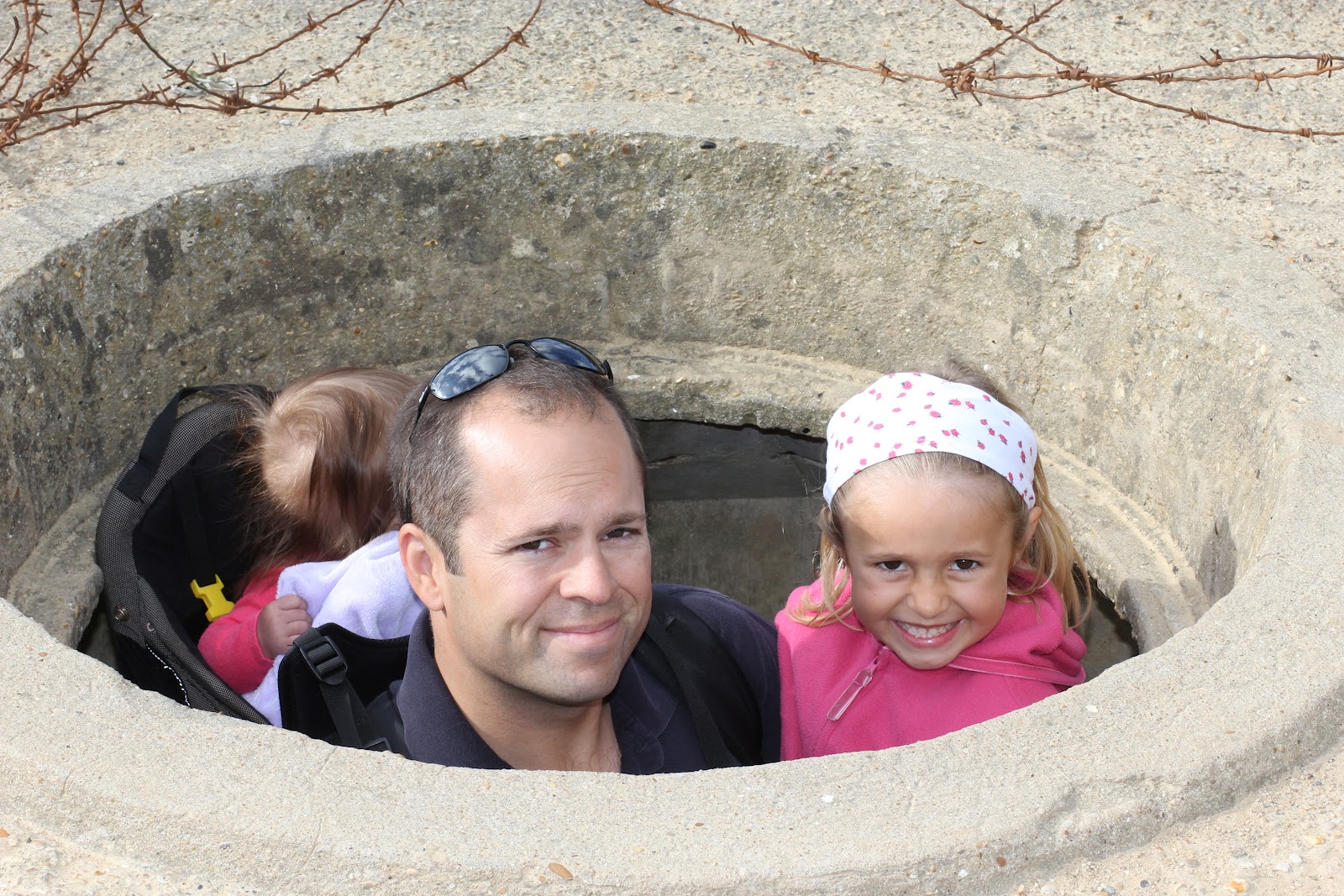
Heading down into a bunker to explore


Saturday, July 7, 2012

Our "Three Hour Tour" off the Cilento Coast

The Pediatric department decided to take a day trip cruise of the Cilento Coast, organized through the QOL committee at the hopsital. As always, the corpsmen were a wealth of information since they had been on a similar cruise. So, we rallied rather early for a Saturday and boarded a bus at 6am to drive nonstop for two and a half hours (despite no bathrooms) to get to the boat. Once there, we boarded the "fishing-boat-meets-booze-cruise" boat, took our seats on the sun deck, and set off!


The kids enjoyed themselves, entertained by applying sunblock for a good part of the time.


The views were amazing!


And a new Pediatric tradition was established (a.k.a. "Gibson's legacy"): kids sippy cups filled with adult beverages in USA koozies! (The kids were eyeing them.)


In the late morning, we arrived at a beautiful private beach to enjoy some swimming for a couple of hours.


Sophia enjoyed some shade-bathing on shore.


 Miranda set about to find some seashells, but was not disappointed to find mostly rocks--big ones at that. All the kids (Sydney, Miranda, Avery and Connor) played in the pebbles (no sand in their suits at least) at the water's edge the whole time.


Sophia cools off with Daddy (and Gibson and Mr. Marty) in the refreshing water.


Here's the view of the beach and the grotto Brian swam to explore with Gibson. I chickened out once we reached the open sea and the wind and waves were knocking into my face and it felt like I wasn't moving despite much effort. I figured one of our girls' parents should live to tell, so I headed back!


Then the boat returned to pick us up for our return trip, which included lunch. We squished into the lower deck, passed around water as we sampled a couple different types of bruschetta. Then we moved onto the main course of pasta with fresh tuna, as we kept an eye out for the vino being passed around. We were especially glad Gibson had taken care of us, since each person in our group received only about 1 to 2 ounces of vino! This is when we realized it was more like a fishing boat than a booze cruise, which was just as well with the kids along.


After lunch, we all got comfy for the boat ride back to our starting point.


Then the boat started to rock and roll...Miranda can sleep through anything sometimes! Many people were seasick and spent their time at the bow of the boat...only Gibson took photos of that!


Sophia snacking on her fingers...until they passed around the watermelon.


Then the wind and waves really started to kick up and the boat started to lean to the right. Sydney didn't seem to mind and fell asleep, which tells you how tired she was...or maybe how much the boat was rocking her to sleep.


Several times the crew would ask us to all sit on the left to balance the boat out. The last time the woman asked us, people were slow to move, so she added, "Quickly!" I sat right next to her holding Sophia on my lap and was honestly afraid we were going to capsize and couldn't help but exclaim/pray, "Oh God!" She tried to reassure me, but the damage was done! I was on alert the remainder of the trip...which was a lot longer than planned.  We half-joked about this being like Gilligan's Island's "three-hour tour" but were lucky it was only three hours longer than planned!

Sunday, April 15, 2012

Matera, Italy

Matera is one of our favorite cities of Italy yet. It is an amazing city unlike anywhere else in the world. This beautiful city of stone dates back to the Paleolithic era approximately 25,000 years ago. It is thought to be one of the first settlements of Europe.

The hilly natural terrain and stone caves lent themselves to shelter. Over time, many houses were expanded around caves and even churches were built out of the caves. Today, many restaurants and hotels are built out of the original caves. We enjoyed the one we stayed at, Hotel Basiliana in San Pietro. It was quite a cobblestone walk from the parking area in the square to the hotel, but worth it for the amazing location (yet all the amenities you'd need) within the caves. 


A church built out of the caves


There are two Sassi (stone) districts, Sasso Caveoso and Sasso Barisano, separated by a ravine called the Gravina of Matera. It is possible to explore them all on foot, although there are many steps.


Our hotel is just below, overlooking the ravine
The city became a UNESCO World Heritage site in 1993, which revitalized the area with tourism. Before then, the area was largely abandoned after the government forcefully relocated the inhabitants because of extreme poverty and unsanitary living conditions during the 1950's. 


Usually a large family, sometimes 6 or more people, would live in a small one-room living space. There was no running water, only a cistern that collected rain water. There was no electricity. Usually there was one straw stuffed bed and some of the children would sleep in dresser drawers. There was one small table for the family and a loom.


The family donkey or mule would also be kept inside the family quarters in a tiny stall to provide extra warmth for the family as well as protection of the animal.


Because of its old world look, Mel Gibson's movie The Passion of Christ was filmed in Matera.